
Catalogue Guide
Jump quickly to sections below:
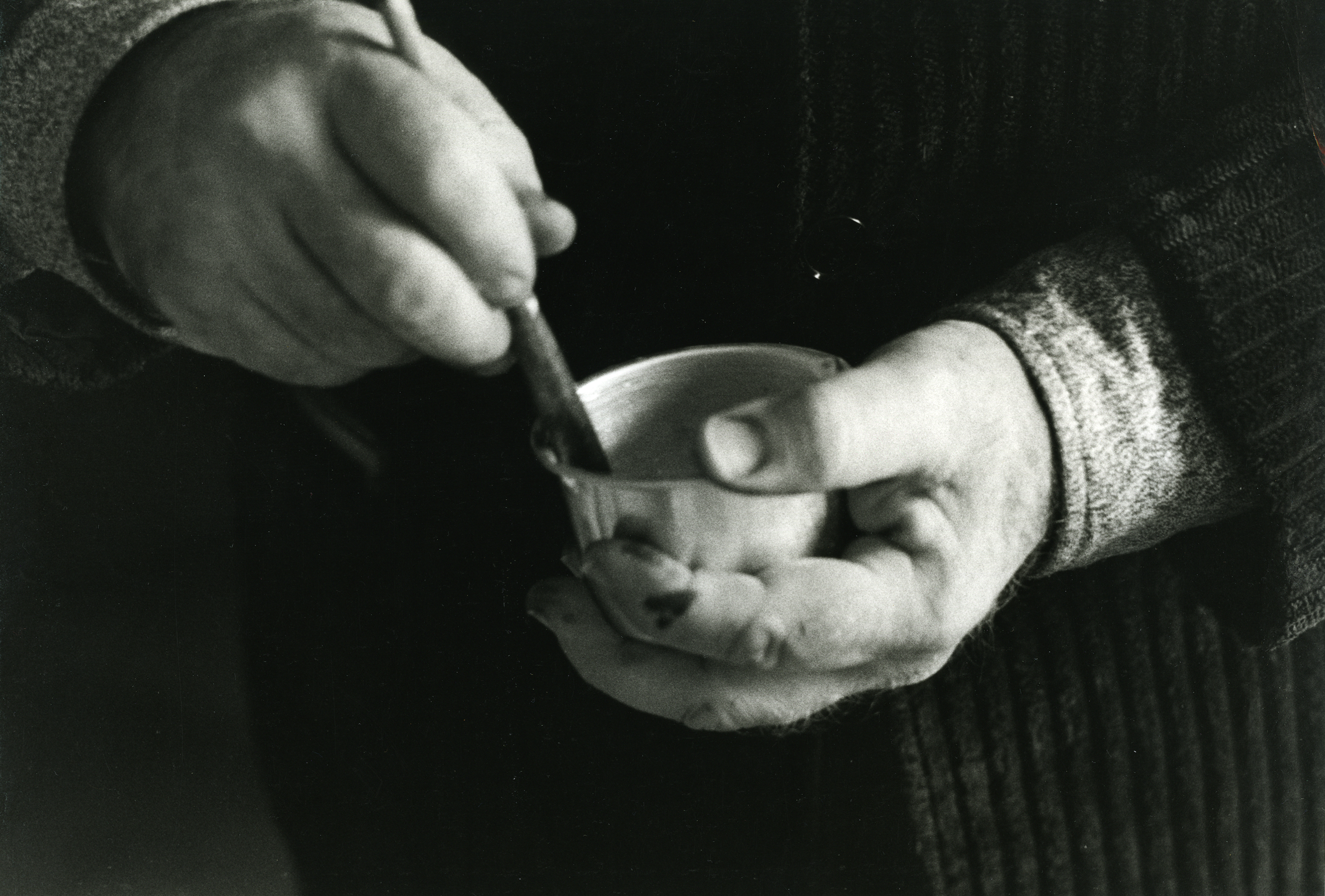 |
| Francis working in Bern studio, Switzerland, ca.1973. Photo © Kurt Blum. |
- Viewing Options
- Images
- Numbering Systems
- Titles
- Artist Date Designation
- Medium and Support
- Dimensions
- Inscriptions
- Creation Location
- Collection
- Exhibitions
- Literature References
- Notes
- Archival Material
Navigation Tools
The default view displays artwork thumbnails in the order of their catalogue raisonné number, with the canvas and panel paintings preceding the unique works on paper. The listings can also be sorted by Francis Archive number, title, height, or width. Select the Filter option to view works by medium, artistic periods, or the Whereabouts unknown category. (Research is ongoing to determine the location of works listed as “Whereabouts unknown.”) To view the full artwork entry from the default view, click on either the thumbnail image or the title. In all other listings, the image links to an expanded view of the artwork image and the title will link to the entry.
In addition to allowing browsing by catalogue entry, the online SFCR offers several alternative groupings of the listings. Artworks can be sorted by Public Collections, Exhibitions, or Literature. Explanations of each of those possibilities can be found on the initial page of that option.
Always use the website navigation and printing tools for the best formatting and ease of viewing.
Quick Search
The Quick Search box in the upper right is for searching a single section only. The box can be toggled to search through other sections on the site. For more complex searches, however, use the Advanced Search link.
Quick search Catalogue Entries by catalogue number, title, or Francis Archive number.
Quick search Public Collections by institution name, city, or state. For countries, use the Filters in this section.
Quick search Exhibitions by year, institution/venue, exhibition title, or city. For countries, use the Filters in this section.
Quick search Literature by author, title, publisher, journal/newspaper name, or year published.
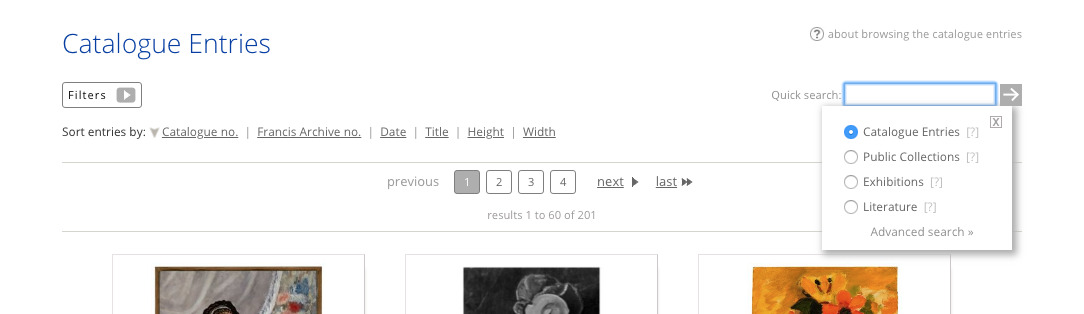 |
| Example of Quick Search options |
Filters
There are Filters within each section to view artworks under several options.
Filter Catalogue Entries by classification (canvas or work on paper), medium, artistic period, or whereabouts unknown.
Filter Public Collections by ownership history (current owner or historical provenance), or country (and state and/or city).
Filter Exhibitions by type (solo, group or traveling), decade, or country (and state and/or city).
Filter Literature by type (book, journal, newspaper article, online-only article, manuscript, auction catalogue, exhibition brochure or exhibition catalogue, decade, or abbreviation (initial letter of last name of the author or venue).
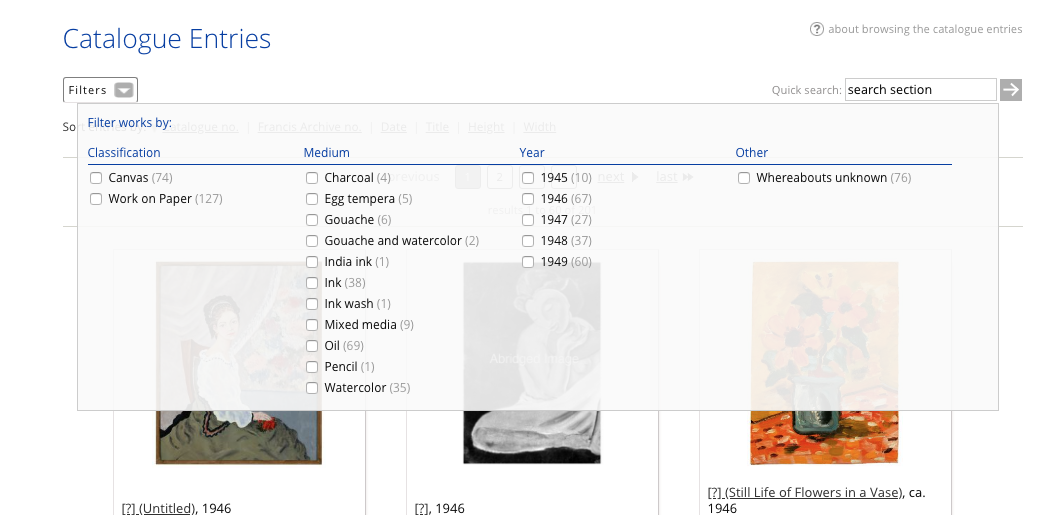 |
| Example of Filter options |
Advanced Search
An in-depth searching option is available under the heading Advanced Search. Each selected criteria hones the search further. To clear search select the “click here to remove all searches” option in yellow bar above.
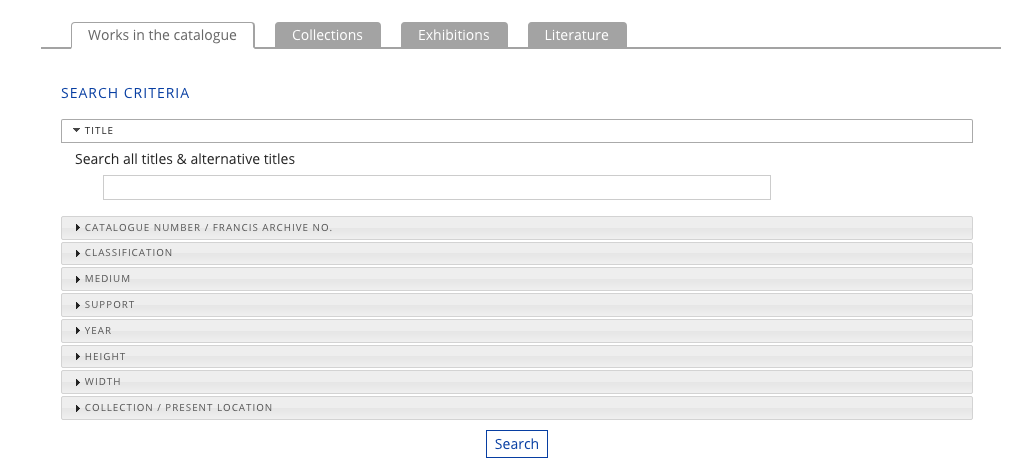 |
| Advanced Search options |
This online "living" catalogue raisonné documents known canvas paintings and works on paper (including unique monotypes, limited edition prints, sculptures, ephemera, posters, etc.) by Sam Francis. This database of Sam Francis entries are filtered in four general classifications updated on a regular basis designated as: Canvas, Unique Work on Paper, Limited Edition, and Other.
For each entry, throughout the thumbnail tombstone information, if a question mark is listed within brackets [?] this designates indeterminate, unknown, or unverified data at the time of publication. It can accompany any text, including title, medium, dimensions, artist date designation, inscriptions, or provenance history.
Each SFCR entry includes the information:
- SFF SFCR Number (and Francis Archive SF Number)
- Recto Photograph of Artwork
- Title (Alternate Title if applicable)
- Artist Date Designation
- Medium and Support
- Dimensions
- Inscriptions
- Additional Notations
- Creation Location
- Collection
- Provenance
- Exhibitions
- Literature References
- Notes
- Supplemental Images (including signatures and views of versos of selected artworks)
- Archival Material (including studio and exhibition images, etc. when available)
 |
|
| SFF4.54 |
All artworks are reproduced in color unless the only available image is a black-and-white photograph (as may be the case for destroyed or lost works). Although every effort was made to obtain high-quality color reproductions, in some instances the only available image was a black-and-white photograph or a poor-quality color image (often a studio Polaroid taken at the time of documentation), so this is the sole portrayal of the entry. The ability to depict color accurately, particularly with some of the older original transparencies or Polaroids, has proven difficult because of photographic variations caused by aging, type of film used, lighting, and processing.
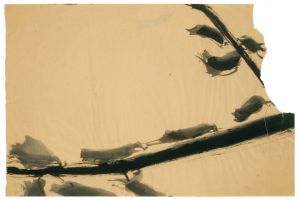
Irregular borders are illustrated if possible, especially for the edges of the paper or when the thick paint has spread outside the edges. If the best possible reproduction of the work includes a frame, the frame is included in the overall image as the primary illustration. This provides a context as well as source information should there be a shadow cast by the frame onto the surface of the work. There are also a number of artworks documented without a visual, as well as others documented only with abridged views.
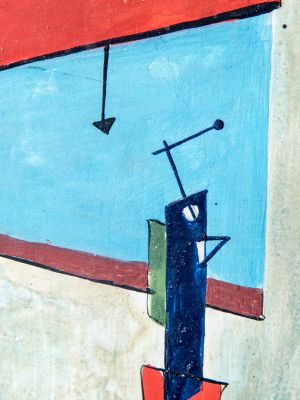
With each entry, a reproduction of the work in the orientation most often documented by the artist or indicated as referenced by the signature is included. Partial close-ups of the work’s surface allow some exploration of Francis’s painting or drawing techniques, application of paint, and brushstrokes.
The source images were resized, color-corrected, and formatted for reproduction in Photoshop. All attempts have been made to reproduce the colors as accurately as possible, using photographic color bars (set at native white point), if available, for the specific illustrations to balance the reproduction quality. However, color accuracy is not guaranteed on individual computer monitors, as there are too many calibration variables affecting the colors.
In addition to the source images, close-ups of inscriptions (when available) are included, as well as alternate orientation views (if applicable) of the specific artwork. From the late 1960s through the 1990s as Francis worked primarily on a flat table or the floor, artworks can be viewed and exhibited from all sides including both vertically and/or horizontally. At times Francis would initially document an artwork one way, then sign it in a different position, and change the installation view yet again for an exhibition. Additional archival material may include photographs taken in the artist’s studio (sometimes showing the work in progress), as well as exhibition and other installation views.
Artworks with only poor reproductions available will not be able to be enlarged past the thumbnail views given.
SFF Catalogue Raisonné (SFCR) Numbering System
The catalogue entries are generally numbered and arranged in the overall artistic periods (1940s, 1950s, 1960s, 1970s, 1980s, 1990s) that the works were likely to have been created. It is impossible to establish a strict linear timetable since Francis did not regularly record his artworks as they were realized. Moreover, as evidenced in his oeuvre over the decades, he did not always proceed in a clear stylistic order. He often went back to an earlier series and created new works in this series at a later date, making it difficult to determine the chronological order. The artist’s extensive travels and multiple studio locations, combined with the fact that some works were destroyed or are still unidentified, further complicate matters. In addition, a number of works—based on similar color, composition, and style within a definitive period of time—have commonly been referred to as series over the years and have been placed together to illustrate the loosely defined groups. While addressing a chronological order when possible, the organization of this catalogue is not stringent and allows for flexibility, primarily in response to the artist’s aesthetics. All artworks may not be documented as some are currently missing, unidentified, or require additional data before they can be assigned a SFF number. There is also a chance that some of the works included could exist with a different title. As artworks are discovered or confirmed, new SFF numbers will be assigned accordingly.
There are two distinct Catalogue Raisonné (SFCR) numbering systems delineating the unique works on paper from the canvas and panel paintings.
The paper works from the 1940s (1945–49) are given the designation SFF4 to indicate that decade and are numbered SFF4.1, SFF4.2, SFF4.3, SFF4.4, etc. Similarly, unique works on paper from the 1950s are numbered SFF5.1, SFF5.2, SFF5.3, etc.; from the 1960s, SFF6.1, SFF6.2, SFF6.3, etc.; from the 1970s, SFF7.1, SFF7.2, SFF.3, etc.; from the 1980s, SFF8.1, SFF8.2, etc.; and from the 1990s, SFF9.1, SFF9.2, etc.
Two-sided works are given subset numbers (e.g., SFF.73 and SFF.73.a), as these have a separate painting on each side of the same panel. Diptychs, triptychs, and other multi-paneled works have a special inclusive number that reflects the work as a whole (e.g. SFF.197.198).
The canvas and panel works are designated from the 1940s to the 1990s with a numbering system that does not include a decade source beginning with: SFF.1, SFF.2, SFF.3, etc.
Unique monotypes, limited edition prints, posters and ephemera have several different numbering systems, including GTW, EXP, Lembark, Litho Shop identification numbers, etc. These are the basic designations:
SFF.1 (for example) = Canvas and Panel Works
SFF4.1 (for example) = Unique works on paper
SFF.P1 (for example) = Posters
SFEPH.1 (for example) = Ephemera (includes sculpture, ceramics, etc.)
These are indicated with each entry.
IMPORTANT NOTES:
- Some entries will appear without a designated Catalogue Raisonné (SFCR) number as they are published "out of sequence" and will be assigned the SFCR numbers eventually.
- SFCR numbers are assigned for artworks that have some documentation in the artist's archives but no images are currently available to positively identify the artworks. These artworks are not published without images, but they are logged into the catalogue raisonne's database for potential future identification.
- Artworks not documented in the artists's records prior to his death and/or have a verified provenance link are not published at this time. These works are currently classified as "pending further research."
- There a few artworks with SFCR assigned that is followed with a question mark [?] delineating unconfirmed attribution at this time.
Francis Archive Numbers (SF Identification Numbers)
In addition to the SFF catalogue raisonné number (which is now the primary identification number), documentation includes the corresponding “Francis Archive,” or “SF,” number previously assigned to the doc card, if applicable. The SF numbers are currently viewed as interim identification numbers, temporarily assigned to artworks attributed to Sam Francis. As already described, identification numbers were assigned by the artist’s assistants at the Litho Shop and usually indicate that the artwork was previously documented in the artist’s archives and/or a definitive provenance link was confirmed. After the artist's death this numbering system continued to be implemented by the Estate and Foundation staff as a means to identify the works in addition to the subsequent catalogue raisonné numbering system.
Over the years, auction houses, collectors, galleries, and museums have utilized the SF Litho Shop identification numbering system as a way of identifying and documenting the works. The letters “SF” designate the classification “Sam Francis Work on Paper” and are followed by the year of completion and an archive number for that year. For example, SF80-10 signifies a work by Sam Francis documented as 1980 and numbered 10 in the sequence for that year. The sequence, however, does not necessarily reflect the actual chronology of the work's creation within the particular year; instead, it reflects the order in which the works were recorded by Francis’s staff. Therefore, a work labeled SF80-10 may actually have been executed after SF80-50.
In some instances an artwork may have multiple Litho Shop identification numbers (two or more), i.e. SF80-10; SF80-110; SF80-130. This simply indicates that over the years it may have been documented by different assistants working in alternate studios, or a number was assigned from a catalogue entry without an image and subsequently the artwork was identified visually. As Francis did not implement a rigid numbering system when completing artworks these duplicate identification numbers may have been assigned years after its completion, and these are listed in numerical order. Artworks on canvas or panels were designated as SFP (“P” for painting).
From the late 195s through the 1970s, Francis’s European and Japanese galleries documented many the works on paper using the word “gouache” to indicate the identification of a unique work on paper. Gouache became a catch-all phrase to differentiate the artwork from a unique work on canvas and was not a definitive confirmation that the medium employed was gouache. Indeed many artworks were created with opaque (gouache) and transparent watercolors, but many documented as gouache in the identification numbers and records are actually acrylic. When the artist’s studio started documenting his oeuvre with the Litho Shop identification numbers some of the works include the designation of a “G” in the number, i.e. G72-101, even though they are not gouaches.
Another documentation notation used by the artist's studio assistants indicated the location where the artwork was painted, i.e. SFT64-100. The addition of the letter “T” in some of the identification numbers was in reference to Francis’s Tokyo studios.
Titles
 |
|
| Francis's handwritten titles from notebook. |
Sam Francis was erratic in providing titles for his artworks, listing the majority as Untitled. At times, however, he did provide very specific titles; he also sometimes gave multiple titles or retitled a work years later or from one exhibition to another.
Over the years painting titles were attributed to the location painted annotations that Francis often inscribed on the verso, i.e. "Sam Francis 1965 Tokyo." Cataloguers, dealers, collectors, and museum curators referenced the city designations as the titles of the artworks when in fact, these notations were the designations of where the artworks were created. Francis would annotate locations painted on the verso of artworks such as Paris, Bern, New York, Los Angeles, etc.
In the SFCR entries Untitled is used when indicated by the artist directly or in subsequent documentation by the artist’s estate. If no title is known or confirmed, it is listed with a bracketed question mark [?]. If an artwork has been referred to with a specific title, but this is not directly from the artist’s records, it appears within brackets, [Red Jewel].
It was not uncommon for Francis (or one of his dealers) to adopt affectionate working titles over a period of time or to use descriptive referents such as Untitled (White, Green, Pink). In some instances, Francis used the words Study or Sketch to identify works created in the preparatory periods leading up to larger murals or commissions. Adding to the disparity in titles is the fact that during the organization of some of Francis’s early solo exhibitions, such as those at the Galerie Rive Droite, Martha Jackson Gallery, Kunsthalle Bern, Museum of Fine Arts, Houston, and Albright-Knox Art Gallery, Francis would submit new checklists, retitling certain works.
Titles are listed in English, even for works that later in his career were often referenced in foreign languages such as French, German, or Japanese in catalogues and other publications, unless Francis specifically designated the title to remain in the foreign language. Titles misspelled in previous publications have been corrected (unless the artist originally misspelled them). If the artist used abbreviations, numbers, symbols, or the like, these have been noted. Works that are part of a series or a grouping include a reference to a numbered sequence. Two basic designations have been used to follow the artist’s numbering system: the abbreviation No. for number and a Roman numeral designation (I). If, however, the artist designated the # symbol, this is included in the title.
Alternate Titles
When a work has been exhibited or listed under a title other than the primary one—as may be gleaned from exhibition catalogues and other publications—this alternate title is listed. If, however, the alternate designation is only a slight variation in treatment of the main title (such as a # sign rather than the abbreviation No.), this is indicated in the Notes section.
The documentation of an artwork's date is based on the information available at the time of the entry's publication as archived in the artist's records and/or augmented with current research. As with titling artworks, Francis was not consistent in dating artworks; often dating artworks years after the completion dates. It is not unusual for artworks to be undated. For clarification purposes, the terms "execution," creation," or "completion" are not used in the dating terminology for the artwork entries.
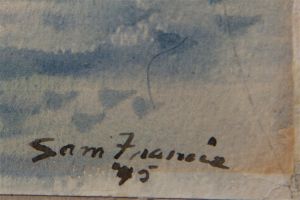
A date is indicated if it is inscribed by the artist. The categories utilized in the online catalogue raisonné provides the data available for each artwork as: “dated as” by the artist, “undated” by the artist, "undated (date)," or with a "[?]" for an unknown designation:
- The date listed is documented with the artist's own date designation, i.e. Dated as 1973.
- If no date is listed it is designated as, Undated. We do not list circa dates.
- If the artwork is undated but there is supporting documentation with the artist’s or studio assistant's notations with a date designation this is noted in parenthesis as, Undated (date).
- If the artwork's inscriptions are unknown, a bracketed question mark denotes this unconfirmed data as, [?].
There are many artworks without dating documentation, but general periods have been attributed over the years with support from the Litho Shop studio assistants doc card records, the artist’s estate records, and other evidentiary information (i.e. exhibitions and publications) as it is available for our review. If there is other verifiable documentation regarding an artwork’s designation this is included in the Notes section of the entry.
One can also review and search the artwork entries with KEYWORDS indexed in general periods of styles by decades, i.e. 1960s, 1970s, 1980s, etc. Often these Keyword Dates correspond with the Sam Francis archive numbers or general decade associations, i.e. SF59-105 is listed in the 1950s, 1970s, and 1980s; while SF72-123 in the 1970s.
 |
|
| SFF4.2 date detail |
The description of the medium and support is based on verified documentation, physical inspection, or data supplied by the current owners. For the works on paper, the type and manufacturers of papers Francis employed have not been specifically notated for each artwork's entry as Francis used a wide variety of sheet and block papers (including handmade ones) as well as from various notebooks from Europe, Japan, and the United States from many different sources.
Here is a partial list of papers confirmed to have been used by Francis over the years: Arches Cover; Arches; Arches 88; Arjomari and Special Arjomari; Commercial Deluxe; Copperplate Deluxe and Special; Crisbrook; Exeter; Fabrino Rosaspina (Vellum); Fabriano Rosaspina (Regular); Fabriano Tiepolo; Italia (also in the 1960s); J. Annonay; Johannot; John Koller HMP; Kasuiri (chine-collé); Kikuban; Kochi Rice; Kozo Red Rice; Lana; Matte Offset Cover; Mochizuki Rice; PTI (#120 Waterleaf); Okawara; PTI (Supra); Rives BFK (sheet and roll); Somerset; Somerset (Satin); Somerset (Textured); Strathmore; Torinoko B; Twinrocker; Vellum; Washi; Whatman; etc. Francis used Rives BFK quite often for its brightness of the white tones and smoothness of texture. It has little sizing so it dampened with water or flow the paper receives the paint and ink with flexibility.
The majority of canvas and panel paintings are on cotton duck, while most of the earlier paintings on linen. The designation of oil on canvas or acrylic on canvas is used interchangeably for linen and cotton duck.
In terms of a canvas or board surface, the artist usually treated the entire surface with multiple layers of gesso, sometimes brushed and later sponged, often with specific tints. There has been some confusion as to whether the fluid, soft cellular forms of his early 1950s canvases were painted with sponges rather than brushes. From hundreds of works studied it has been determined that after the gesso was applied, Francis did not use sponges to achieve his subsequent layering of the thin watery layers of paint (details of his techniques are further illuminated by Debra Burchett-Lere and Aneta Zebala in a paint study with the Getty Conservation Institute -- see note of publication below). In fact, Francis's frustration in how his painting techniques were described was noted in a letter from Kenneth Sawyer to the artist Claire Falkenstein (Paris-May 23, 1954) where Sawyer states that Francis was 'furious' about an article in Art Digest by Michael Seuphor commenting that Francis's cellular paintings were executed with a sponge. These antecdotes as well as other information obtained by studio photographs, documentation of the artist working on paintings, first-hand testimony of Francis's studio assistants, conservation studies, and scientific testing are included in this catalogue raisonné text, often highlighted in the Notes section accompanying painting entries.
Notations regarding stretchers or strainers, possible relining of the canvas, or other issues pertaining to the works are not generally indicated (unless information is known) as this data may not be updated at time of publication. It is important to note that the process of relining canvas works was not unusual with Francis's paintings from the 1950s and 1960s -- the most usual reasons due to the chassis being visible through the canvas or the need for additional support for the canvas. If Any additional research known on specific paintings is included in the Notes section with each entry. In California Francis worked often with Lucius Hudson and Greg Mahoney (G. M. Art Structures) who fabricated his stretchers or strainers.
 |
|
| Detail of SFF.5 |
The basic terminology for the materials used—acrylic, charcoal, gouache, ink, oil, pencil, watercolor, etc.—is notated without naming the specific manufacturer of the pigment or colors. Early in his career, Francis used a variety of traditional, commercially available oil-based tube paints, which he often combined with such media as egg tempera, dry pigments, Damar resin, and binding agents. During the 1960s through the early 1980s he relied on specially designed paints mixed for his specific needs. Beginning in the mid-1960s, Francis’s studio assistants, most notably Daniel Cytron, would mix specially formulated dispersions to create a unique palette of vibrant and intense colors. Because of the variations in the paints used over the years and the preparation methods employed, the descriptive categories have been reduced to simplified terms: acrylic, casein, egg tempera, mixed media, gouache, watercolor and oil. There are a number of works where the medium cannot be verified as the artist would often use a variety of paints in one composition including acrylic, ink, watercolor, and oil that are difficult to discern or confirm without scientific testing. In these instances the works are listed as mixed media, highlighting questions in the classification of the materials. Francis also created collaged works that are included here.
The unique compositions on paper catalogued in this publication include works on handmade papers (often used for the monotypes) paperboard, cardboard, and the like, as well as works on gessoed (prepared) paper, or paper mounted onto other surfaces (i.e. canvas or board). If research confirms that Francis worked on a prepared paper surface this will be annotated in the Notes section.
Unique works on paper (also interchangeable referred to as paintings, drawings, sketches and studies) included here are directly applied to a surface that usually requires a frame or glass/Plexiglas to be displayed. However, the use of gessoed paper allowed Francis to exhibit these works without glazing. As mentioned above, specifics on types of papers employed are not generally indicated unless there is a specific commentary included in the Notes section, often designating unique handmade papers.
Francis created many small calligraphic-style ink and/or acrylic sketches on paper (often torn out of his sketchbooks or scraps of paper in the studio) that were studies for Enso shapes, Lapis Press and Wind Harvest logo designs, exhibition posters, book covers, etc. These are included in the documentation of his oeuvre as individuals works.
If the Foundation has knowledge of any physical or technical analysis of the works or the materials of which they are composed, that information has been added to each entry's research file. Items of interest are periodically published in the Notes section for each artwork.
A detailed study focused on Francis's paints and materials is available for further research on the artist's paint methods published in February 2019. Authored by Debra Burchett-Lere and Aneta Zebala, Sam Francis: The Artist's Materials is part of the series of publications from the Getty Conservation Institute, Los Angeles.
Limited Edition Prints
Documentation of limited edition prints (including lithographs, etchings, screenprints, etc.) as well as unique monotypes with mixed media applications are included with additional information on medium, editions, printing techniques (if applicable) as these works employ a variety of processes. Basic terminology for the limited edition prints are divided into different groupings such as: L, for lithograph; I, for intaglio; S, for screenprint; P, for poster; or A, for the Anima group of self-portraits. As Connie Lembark notes in the 1992 catalogue raisonné of prints, little documentation exists of the earlier print editions (especially from the 1960s), so much of the documentation in existence is derived from published sources or culled data from the examination of the completed editions. Lithographs are generally printed using the direct process; the intaglio prints are designated by more general terms, for example an aquatint may include sugar-lift, spitbite, or hard-ground aquatint. Variants in the edition may be unique, include hand coloring, monoprinting, or other variations. The basic Key to the Proofs is listed in abbreviations: BAT = bon à tirer; AP = artist's proof; TP = trial proof; CTP = color trial proof; PP = progressive proof; WP = working proof; UP = unique proof; SP = special proof; XP = experimental proof; S = state proof; V = variant proof; A = archive proof; C = cancellation proof.
Artworks are listed with unframed dimensions, measuring the overall image on the support (without the mat or frame) from edge to edge. If it was only possible to measure the work in the mat or frame, this is indicated.
Height precedes width, and centimeters precede inches (in parentheses). For irregularly shaped works, the dimensions are listed as approximate and noted before the measurements. Fractions of inches are given to the nearest sixteenth. If approximate, the dimensions have been rounded up for purposes of this catalogue. Generally the metric dimensions were calculated mathematically based on the dimensions in inches rather than being a true measurement of the work. In certain instances, the dimensions listed may vary from previously published notations as works may have been measured by a variety of individuals over the years. In a few instances, where measurements were not available, the size has been estimated, and this is indicated.
Inscriptions in the artist’s hand, giving such information as the date, title, and identification number, are listed under the main heading.
If listed as signed, it is believed the signature is in the hand of the artist. The locations of the inscriptions are cited if known, with “recto” indicating the front and “verso” indicating the back of the artwork. The inscriptions are usually annotated directly on the canvas or paper surfaces, however, some of these can be annotated elsewhere (such as on the backing board, stretcher bar, overlap, etc.) so these variations are mentioned in the Notes section.
If possible, all notations by the artist are recorded as written, with the exact spelling (including errors), uppercase or lowercase letters, and any other notations. When signed, the majority of artworks are in a cursive handwriting format. Sometimes signatures are printed, and at times Francis would include his full name: Sam Francis, and other times he would abbreviate his name, or use initials. A sample signature notation thus might read: Signed, dated and titled on verso in black paint: Sam Francis Grey Coast 1950. If it is documented that the work is signed and dated, but there is no record of the exact wording, it reads simply: [Unconfirmed] Signed and dated. If the work is unsigned and undated, it reads: Unsigned and undated. If inscription information is currently unavailable, the citation reads: [?].
It is not uncommon for an artwork (canvas, works on paper -- including monotypes and limited edition prints, etc.) to lack any inscription or signature, since Francis did not have a set procedure for signing and dating his work and was reluctant to sign anything, even if requested to do so by his dealers or collectors. When asked about his omission of a signature, he commented: “Not signing is not a protest or a purposeful act but it just did not enter my thinking; maybe I just did something else that day.” In cases where he did use an inscription, he did not follow any definitive signature format. Periodically, Francis would sign his full name; frequently he would use his initials; on occasion, he would sign his name with a title and date; and intermittently he would just include a date or location.
Sometimes either the artist or studio assistants inscribed “top” or drew a directional arrow to show the preferred orientation, and this information is included in the Inscriptions or Notes section. At times, there is an additional notation, the initials “P.M.” or "PM," usually inscribed by the artist. This was Francis’s abbreviation for “Private Museum” (his personal reserve), an indication that the work was not to be sold but set aside and put in his own private storage in his studios or at Galerie Kornfeld in Bern. In his inscriptions Francis also often designated a location, such as Bern, Paris, or Tokyo, to reference the city where the work was created. He used the broad designation “Los Angeles” to refer to his Santa Monica and Venice studios in Southern California.
 |
|
| Verso signature, date and inscriptions on SFF.60 |
Commentary and Additional Data in Notes (Commentary)
In addition to clarification of the information presented, the Notes sections include complementary data as well as quotes or references by the artist or others if pertinent. Summary notes are not generally included in the entries, as well as information on techniques, or general art historical comments, as these writings are available to the reader in the bibliographic materials cited. However, some commentary is included if it provides additional historical information specific to the work.
This category also references notations not in the artist’s hand such as gallery dealers, auction houses, museum staff, framers, or shipping companies. These additional inscriptions are generally written directly on the verso of artworks, the supports or frames.
Artworks documented in the artist’s estate (as of November 1994) usually include two stamps on verso: “Sam Francis Estate” (in a logo format) and a facsimile signature stamp “Sam Francis” and are listed in this section.
If Francis’s designated studio assistants or staff of the artist's estate or foundation have added notations referring to their inventory numbers, dimensions, reproduction numbers, titles, orientation, or the like, this information is also included in this section. Labels affixed to the verso of an artwork or accompanying backing board are not fully described unless historically significant.
A brief summary of provenance history (not necessarily in chronological order) is notated in this section if confirmed.
This field delineates the city (or state) where the work was created. At times, the specific studio used (e.g., Broadway studio in Santa Monica or Akasaka studio in Tokyo) is delineated in the Notes section if confirmed. If specific information is known from the artist's notations regarding the studio or city this is included in the entry.
Francis used the term Los Angeles to represent the general region in southern California where he worked. Sporadically he would inscribe Los Angeles or L.A. on the artwork's verso, usually in pencil. Technically, he painted in his studios located in the Santa Monica and Venice, California neighborhoods.
All artworks originated with the artist, so his name is implied as the first owner in the provenance history, including when an artwork was transferred to Francis's estate and foundation.
Detailed provenance history is not listed in chronological order. If there are any collections of particular historical interest these are notated in the artist's archival records and will be mentioned in the NOTES section with an artwork's entry.
Only the current, or last known owner's information is published, listed as COLLECTION:___. Every effort has been made to phrase the ownership credit according to the owner’s instructions, including the accession numbers for museum collections (if stipulated) and references to acquisition by bequest, gift, or donation. Whenever possible, the current owners (including institutions) were asked to complete a questionnaire on the work, its provenance, and its exhibition history to substantiate and corroborate information in our files. If necessary, additional documentation and photography of the work were secured.
In cases where the current collector prefers not to be named or the provenance is unclear, the following designations are used:
- Private collection: This listing indicates that the work has been verified to be in the hands of a private collection, but the collector wishes to remain anonymous. If the collector agrees, the city, state, or country is given.
- [?]: Unverified provenance history
- Unverified collection: The current location of an artwork may have been reported to us via the prior collection or another source but if not confirmed it is not included without preferred credit listing.
- Whereabouts unknown: A number of works were initially documented in the archives, but their provenance history is unsupported. Some of these works may have been destroyed. In any case, information or validation of their existence is incomplete and unverifiable at this time. Alternatively, this designation is used in instances where the current location within the last 10 years is not confirmed even though the artwork may still be in the last known collection.
Provenance history published is not a verification or certificate of transfer of title for an artwork. It is impossible to track this information as many transactions are private, unrecorded exchanges. For example, some transfers are between family members through inheritance, or artworks that were given to friends and family by the artist that may not have been recorded in the artist's archives. Many artworks have verifiable provenance history which aids in our research process confirming sales information, gallery consignments, exhibition loans, and literature references.
Information regarding auction history is listed under Literature References. When available, external links to the URL for the main auction sale catalogues are cited.
Where applicable, the exhibition history for each artwork includes both solo and selected group shows listed in chronological order, from earliest to most recent, with venue, city, title of exhibition, and date. If an artwork was included in an exhibition and cited in the checklist or illustrated in the catalogue, it is referenced in this section. Accompanying catalogues and Additional venues are cited if applicable (which are not repeated in the selected Literature References). If an artwork was not exhibited in the show, but is referenced in the catalogue in an essay or image, it is included in the listings under Literature References (see below).
When the citation in an exhibition catalogue is confirmed, the entry states that the work is illustrated. For example, “no. 3, p. 25, ill. in color” indicates that in the exhibition catalogue the work is numbered 3 and illustrated in color on page 25. Page numbers for the illustration, not for text references are cited. A black-and-white reproduction is cited as “ill. in b/w” and, if unverified if the illustration is color or black-and-white, then it is listed as “ill.”
Works in continuous long-term exhibitions at public institutions are not generally listed in the entries, but a few are noted.
Limited edition prints are included in many shows around the world due to the expanded number of prints available in any given edition. Often when cited, the editioned image is exhibited and notated as such (i.e. Doubled Cross, 1973, L-168 or SF-188), but the actual edition number of the proof that is shown (i.e. 2/30) is not specified or known.
 |
|
| From the Literature References in Sam Francis Archives |
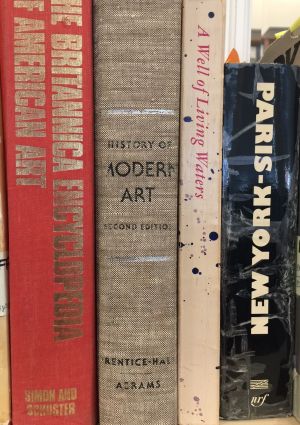
The published literature references – the bibliography – specific to the artwork entries are listed chronologically by author or editor or by publisher. For edited volumes, the editor(s) are listed first with any other authors listed in order of appearance in the publication when known. Gallery and museum catalogues are generally listed by author or venue. Essays or texts within catalogues are listed as separate entries within the main book or catalogue.
Page numbers, if available, are cited for illustrations. A color reproduction is cited as “ill. in color,” black-and-white reproduction is cited as “ill. in b/w,” and, if still unsure if the illustration is color or black-and-white, it is listed solely as “ill.” The illustration notation is assigned to an artwork when it has been reproduced in full as a referential image within a publication. Documentary and historical photographs are not listed under Literature References for any artwork.
Because of Sam Francis’s international stature, an abundance of references exist in publications throughout the world. The bibliography includes only those articles, reviews, catalogue essays, and books that provide substantive or historically important discussions of the artist or his work or present illustrations of his works. For the SFCR entries, the references are included if an illustration of the work is available. External links to online publications have been incorporated if available, as many substantive publications are now online.
Archival Materials
This section includes supplementary photographic images showing views from the artist’s studio (sometimes showing the work in progress), exhibitions, and other installation views when available.
Educational Documentation
The SFCR (catalogue raisonné) is not presented as an authenticator, nor should it be construed as an absolute accounting of Francis’s works. In researching and organizing the data, the mission is to document and confirm the information in an educational chronicle. Some artworks have sanctioned data, while others are subject to change as new facts are revealed with continued scholarship.
This information is provided as a courtesy only, and neither the person to whom it is provided, nor any other person, shall be entitled to rely on the accuracy thereof. The Sam Francis Foundation shall have no liability whatsoever to any person or entity by reason of this information. We reserve the right to modify or declare this data invalid as to attribution, identification number, and/or other information at any time without notice. Assignment and inclusion in this publication are not a certification of authenticity, confirmation of title, or provenance. The Sam Francis Foundation is involved in the ongoing evaluation of works attributed to the artist and does not render opinions concerning authenticity; it provides information for educational purposes only. Neither the Sam Francis Foundation nor any of its representatives, directors, officers, employees, agents or representatives, or others acting for any of them, or their successors, warrants or represents the authenticity of the work or the capacity of any party to convey title thereto.