
About the Project
This project includes the ongoing publication and documentation of archived artworks.
Please check back often to review updates on a regular basis.
Debra Burchett-Lere, Managing Editor / Executive Director
Beth Ann Whittaker, Project Coordinator
Organization
The artworks are organized by catalogue numbers as explained below. The online version will be continually updated and is organized to function as a traditional printed catalogue raisonné, with each work identified in a sequential and essentially chronological order. Corrections and updates for the entries and additional documentary materials will be posted at regular intervals (e.g., weekly or monthly) as new information comes to light. Any new information will be time-stamped on the website as changes are published.
The current compilation is published with the understanding that the Sam Francis Foundation (SFF) does not authenticate artworks, so that inclusion in this online catalogue of entries does not serve as a certificate of authentication. The primary objective of SFF is to collect and preserve information regarding the works of Sam Francis and to educate the public concerning these works with an ongoing discourse about his life as an artist and oeuvre from 1945 – 1994.
Research
Questions of attribution, dating, exhibition history, medium, origin, provenance, and signature are considered. Documentation has been consolidated and compared with the artist’s records and other archival materials in collaboration with insight from studio assistants, art dealers, curators, collectors, family members, and scholars. The information presented has been compiled with due diligence and is considered to be as accurate as possible at this time. Given the nature of Francis’s studio practices, however, we cannot guarantee that this information is all-inclusive, as new discoveries continue to be made. Because of inconsistencies in the artist’s records, it is impossible to provide definitive statistics on every work. The lack of complete, intact records and the inability to verify all details prior to the artist’s death have meant that the data may be more specific for some artworks than others.
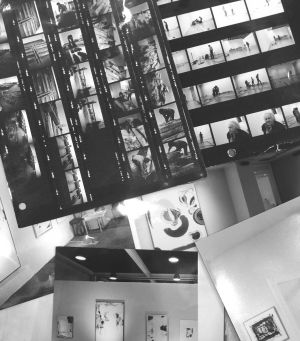
The primary resource for the information presented here has been the artist’s archives, which have been continuously maintained and updated since the artist’s death. SFF has been collating the records from the artist's studios, homes, and storage spaces as well as his gallery dealers since 1995. These records include business correspondence, catalogues, exhibition records, inventory cards, letters, photographs, writings, and ephemera. A large portion of these records have already been categorized and accessioned by the Getty Research Institute, Research Library Special Collections, Los Angeles, archived as the “Sam Francis Papers.” Additional material is currently housed in the Sam Francis Foundation’s inventory and will be accessioned by the Getty at a future date.
 |
|
| Archival photographs in the Sam Francis Papers |
This compilation represents the best efforts of SFF to document the known works on paper and canvas from 1945 to 1994; added in regular increments. It does not claim to be a complete record of the artworks of these decades, and the information presented here is subject to change as scholarship continues. We are engaged in ongoing research as an indeterminate number of works are still in undisclosed, private hands or no longer extant. Evidence compels us to keep searching for artworks, including “hard-to-decipher” images of works in personal photographs, discussion of works in letters from friends and family, and documentation (“doc”) cards with data on artworks written by Francis and studio assistants over the years. Over the course of his career, artworks were sometimes sold or given to friends and collectors without being registered with a date, dimensions, or visuals.
Since 1995, a concentrated effort has been made to encourage submissions for consideration. We have placed advertisements and inserts in the major art magazines and auction catalogues as well as utilizing online mailings, regular mailings, and personal contacts with all known collectors, dealers, and museums throughout the world. Whenever possible, the artworks have been inspected and photographed in the preparation of this catalogue, but unfortunately this has not been possible for every piece. Efforts to substantiate the existence of some works or trace their present whereabouts have been unsuccessful, but it is our assumption that with the publication of this catalogue more of these privately held artworks will be discovered. To respond to this new information or corrections, we intend to provide updates to the entries at regular intervals. Every artwork entry will be time-stamped with the exact date it was updated. Therefore, the current compilation is a work in progress, subject to changes along the way. We are confident that with updates augmenting the cataloguing process the most accurate narrative and encompassing document will evolve. As some information collected relies on the testimonies of others, the SFF employees, officers, directors, or their agents shall not have any liability for any inaccuracy or incompleteness in the information provided.
Sources of Information
During his lifetime Francis generally resisted requests to fully catalogue his artwork with classification numbers, so there was no formal system for photographing or identifying works immediately after they were created. In particular, works given as gifts to friends or family often left the studio without being documented. Although his studio assistants from the late sixties to the nineties described Francis’s working style as encouraging a “spirit of chaos,” he understood the logistics of conducting business and ultimately a basic registration procedure was enacted, especially as his repertoire of artworks expanded. Through the efforts of his assistants—including Maria Reinshagen, who in the late 1960s started documenting the works on paper, and Nancy Mozur and George Page, the directors from the 1970s to early 1990s of the Litho Shop, Francis’s business office and print studio—an identification numbering system evolved. Identifying numbers were assigned to a large percentage of the artist’s oeuvre before his death and usually listed on a Litho Shop documentation "doc" card, providing crucial references for the current endeavor.
These analog “doc” cards, which were subsequently maintained and updated by the Sam Francis Estate and the Sam Francis Foundation (SFF), were the starting point for the research process. The data had generally been either handwritten or typed onto five-by-seven color-coded inventory cards (blue for canvas and panel paintings, orange for paper, and pink for monotypes) with an image (usually a Polaroid snapshot), an identification number (SFP for canvas paintings, SF for works on paper, or SFM for monotypes), and additional remarks pertaining to each work. The SFP and SF numbers, which classify works by year, provided a degree of corroboration in many instances with the artist’s exhibition, gallery consignment, and sales records (although the records do not always distinguish between consignment and sales). Francis sometimes added his own handwritten notations on the doc cards regarding dating, signature, title, and provenance.
As our arduous research progressed, we discovered duplicate entries for artworks identified with multiple numbers or data and images of pieces “in progress” that had been previously documented. Properly connecting incomplete doc cards to specific artworks became a process of elimination (and often illumination), especially when we had only fragments of information such as just the dimensions, or the name of a former collector, or a photograph. At times research into Francis’s timeline revealed inconsistencies in the earlier chronologies and published biographies, affecting numbering sequences. Every effort is made to verify information and secondhand data.
Additional gallery and museum records, consignment memos, exhibition checklists, inventory cards, photographs, sales records, and discussions with studio assistants have provided guidelines for presenting Francis’s works in logical groupings. In assigning a sequential order to the artworks and updating the specific data related to each work (date, medium, title), we discovered that the artist himself, in recollecting a work's history years later, may have initiated many of the inconsistencies. In compiling these entries, it has been necessary to reconstruct the exhibition histories, review photographs of the artworks in studio views, and correct any erroneous information printed in previous publications.
Although not fond of record keeping, Francis fortunately retained much of his written correspondence over the years, so we have been able to use this for corroborating data. Of particular importance in identifying the early works were archives from the artist’s father, Samuel Augustus Francis, and his stepmother, Virginia Francis, from the 1940s and 1950s, as well as letters and photographs from his first wife, Vera Miller Francis Fulton. Works from the 1950s and 1960s (which will be detailed in subsequent issues) were often identified with the aid of documents and correspondence to and from his gallery dealers, including his primary dealers during those decades: Galerie Kornfeld, Bern (which continued to be Francis’s primary dealer and business contact through the early 1990s); Martha Jackson Gallery, New York City; the Minami and Nantenshi galleries, Tokyo; André Emmerich Gallery, New York; Gallery Delaive, Amsterdam; and Smith Anderson Gallery, Palo Alto, among others. We continue to review research questions and have ongoing dialogue with galleries such Kornfeld, Nantenshi and Delaive as well as his studio assistants. Additional resources included an unpublished manuscript from 1969 by Betty Freeman (“Sam Francis: Ideas and Paintings”) and the André Emmerich Gallery records and papers (ca.1954–99) in the Archives of American Art in Washington, DC. From the early 1970s to the 1990s, the Litho Shop maintained fairly comprehensive correspondence files, including gallery and museum histories.
Numerous research libraries have been accessed, including the Archives of American Art, City of Basel Archives, the Getty Research Institute, the Los Angeles County Museum of Art Library, the Morgan Library in New York City, the Guggenheim and Whitney archives, the New York University, Buffalo archives, the Tate, the Stedelijk, University of Washington, Seattle, as well as libraries of the Museum of Modern Art in New York, the San Francisco Museum of Modern Art, and the University of California, Berkeley and Los Angeles, among others. In addition, countless exhibition and accession records from registrars at museums throughout the world have provided valuable resource confirmation. Records pertaining to the major survey exhibitions at the Kunsthalle Bern, Kunsthalle Basel, Albright-Knox Art Gallery, Idemitsu Museum of Arts, Kunst- und Ausstellungshalle der Bundesrepublik Deutschland, Jeu de Paume, Centre Pompidou, Museum of Contemporary Art (MOCA) in Los Angeles, and Museum of Fine Arts, Houston, have provided verification of facts pertaining to artworks exhibited in those venues. In particular, the 1993 retrospective in Bonn, Germany, organized by Pontus Hultén, and the 1999–2001 show originating at MOCA, organized by William C. Agee and Kathleen Bartels, have helped confirm data. In addition, the extensive research as well as firsthand dialogue with the artist by the art curator and scholar Peter Selz, in connection with his 1975 monograph Sam Francis, revised in 1982, has been a valuable resource. Research for the Getty publication, Sam Francis: The Artist's Materials (published February 2019 by authors Debra Burchett-Lere and conservator Aneta Zebala) provided additional confirmation of dating, medium, and history on some of the artworks and Francis's paint methods.
 |
|
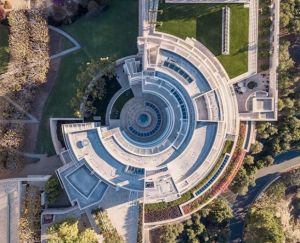
| Aerial view of Getty Research Institute |
To further aid the piecing together of evidence and constructing a summary of the artworks, we have relied on other personal records, including memos, passports, marriage and death certificates, legal papers, military papers, memorabilia, photographs, and letters. Most of these documents are itemized on the Getty Research Library’s call list for the Sam Francis Papers (2004.M.8) or are in the process of being inventoried for transfer to the Getty. In addition, the 100-plus oral history interviews with assistants, curators, dealers, family, and friends filmed and produced with Jeffrey Perkins and other interviewers including Natalie Adamson, Elizabeth Buhe, Gabrielle Selz and Richard Speer have provided important corroborating data. A complete listing of the oral history transcriptions will soon be listed on SFF's website in conjunction with the Getty Research Institute.
Research Team: Natalie Atiee, Brittany Binder, Michelle Garcia, Helen Kuskin, Allan Peach, Edward Ridgeway, Beth Silverman, Sofia Staab-Gulbenkian, Spencer Lere, Aneta Zebala